

My kayak is one of my favorite ways to spend an afternoon, but my storage situation for it had become embarrassing. It was just leaning against the wall of my garage, waiting for me to do something about it. Add to that two paddle boards that were buried somewhere behind a pile of garage clutter, and the whole setup was past the point of being workable. It was the kind of project that nags at you every time you walk by it, and I finally carved out a weekend to actually fix it.
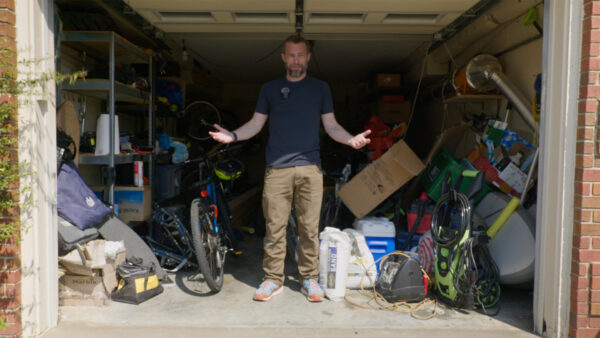
The garage itself had been in rough shape for a long time. It wasn’t that fixing it would take forever. Honestly, it wouldn’t. The hard part was justifying the time when there were always more “important” projects waiting in line. The kayak and paddle boards were the main issue, but the whole space had gotten away from me. Tools, sports gear, car parts, and random stuff had piled up in ways that didn’t make sense anymore. If I was going to make room for a new rack, the rest of the garage needed attention too.

What I actually wanted was a single spot that could hold the kayak and both paddle boards together, with easy in-and-out access. The catch is that all of those things get wet. They need to dry off before going back into the garage, which meant the rack also needed to live outside sometimes. So I sketched out a three-tier rolling cart on the whiteboard. Top tier for the kayak, two lower tiers for the paddle boards. Roll it out to dry, roll it back in when everything was ready to be put away.

Wood was out. Anything that’s going to be wet on a regular basis is just asking for trouble if you build it from lumber. PVC made way more sense for this kind of thing, but PVC always has the same problem, and that problem is joinery. Walk down the plumbing aisle at any home center and you’ll see plenty of connectors, but they’re all designed for plumbing, which means they don’t really help if you want to join five pieces of pipe at one corner. That’s where this project was going to live or die.
While poking around online I found a company that makes connectors specifically for furniture and structures built from PVC. Five-way fittings, four-way fittings, three-ways, and corners covered basically every joint configuration I’d need. They even had inserts designed to hold caster posts, which meant I could turn the entire rack into a rolling cart without any sketchy workarounds. I ordered a big box of connectors and grabbed all the pipe I needed locally. Plain white pipe, since the connectors come in colors and I was going for function over fashion anyway.
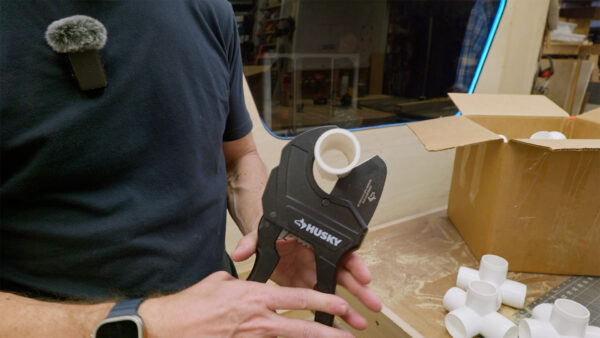
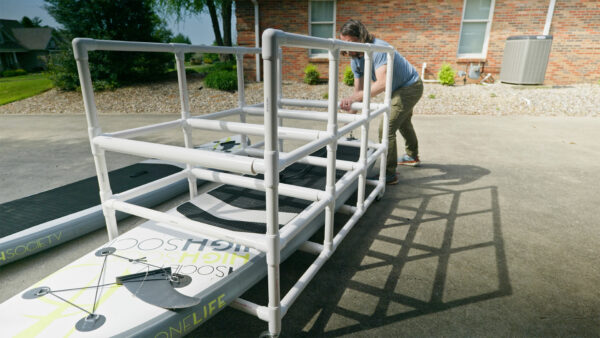
Over the years I’ve cut plenty of PVC with a hacksaw (slow) or a miter saw (loud, dusty, and full of staticky plastic shavings that get everywhere). This time I used a ratcheting PVC cutter, which made the whole job almost embarrassingly fast and clean. I had a lot of 1-1/4″ pipe to get through, plus some 2″ pipe for what I had planned next. With everything cut to length, I laid the entire rack out on the garage floor before assembly. With this many identical-looking pieces in white, getting it right on the floor first saves a ton of confusion later.
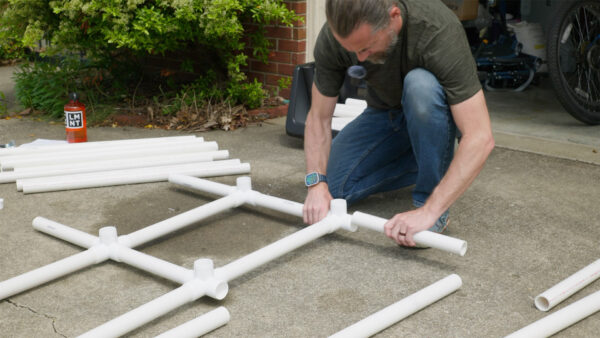
Assembly was straightforward once the pieces were sorted out. The connectors fit tight, which is exactly what you want, and no glue is needed for something like this. One detail I worked in: instead of just having the kayak slide directly across PVC, I made rollers from the larger 2″ pipe by sliding it over the smaller frame pipe.
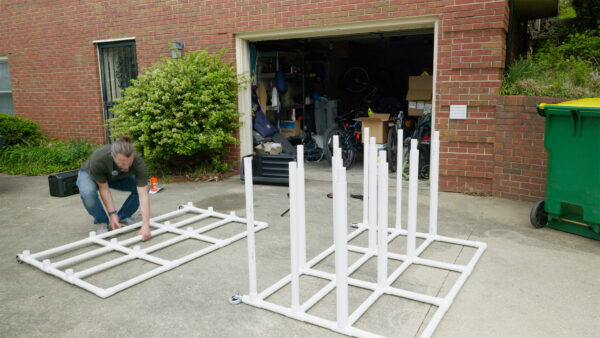
Four rollers across the top tier for the kayak, since it’s heavier, and a single roller in the middle of the paddle board tiers since those are lighter. Casters got mounted to the bottom corners, and the whole thing actually turned out a lot sturdier than I expected.
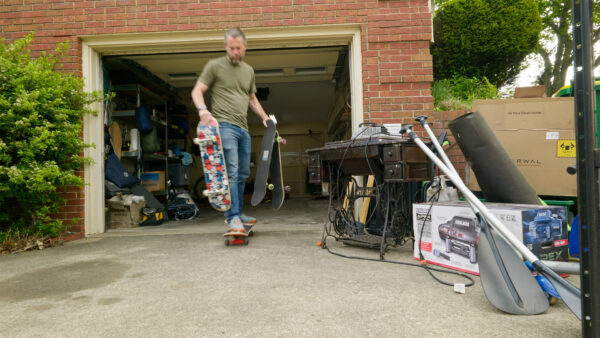
Before I could test the rack with the actual paddle boards, I had to dig them out from the disaster behind them. So the garage cleanup happened. A lot of stuff got tossed, a lot got reorganized onto shelves, and I separated everything out by category, including automotive, sports gear, camping, and so on. I also set up a dedicated automotive cart that I can roll out to the driveway when I’m working on a car, which solves a real problem I’ve had for years. The whole thing took the better part of a weekend, but the difference was night and day.
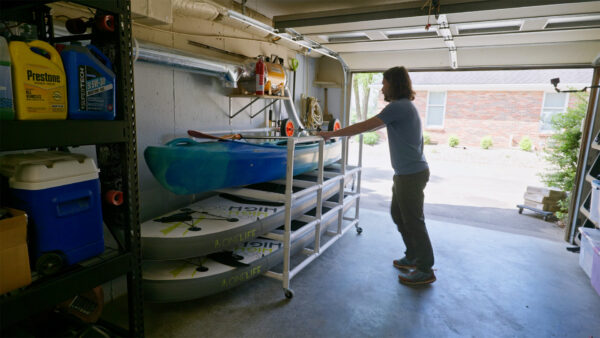
With the garage actually walkable again, I rolled the rack into place and loaded it up. The paddle boards slid onto their tiers without a fight, and the rollers definitely helped there. The kayak was the bigger question, since it’s heavier and sits on the top tier. Lifting it up there was less of a problem than I worried it would be, and the whole loaded rack rolled around with no drama. It also fit into the spot I’d planned for it without crowding out the mower, which was a small but satisfying win. The cart does exactly what I wanted it to do.
The bigger lesson from this build wasn’t really about the rack. It was about the value of a weekend spent improving a space you use every day. Garage projects always feel hard to justify when there are bigger builds in line, but the payoff lasts way longer than you’d think. The space works better for me now, my family can actually find what they’re looking for, and the gear we actually use is ready to go instead of buried. Thanks for hanging out for this one. Now, go make something awesome!
TOOLS
(purchasing via these affiliate links supports ILTMS)
Woodworking
- SawStop cabinet saw
- 8″ Dado stack
- Skil circular saw
- Dewalt 20v drill driver combo
- Dewalt Miter Saw
- Jet Wood Lathe 12×21
- Carbide lathe tool set
- Countersink drill bits
- Dewalt DW735 benchtop planer
- Orbital Sander
- Pancake compressor/nail gun combo
- Dremel tool
- Incra box joint jig
- 54″ Drywall T-Square
- Push Blocks
- Jigsaw
- Shop Fox 6″ Jointer
- Grizzly 14″ Bandsaw
- Grizzly Drill Press (WAAAAY overpriced (3x) on Amazon, buy from Grizzly directly.)
- Jet Drum Sander
- Kreg Rip Cut (circular saw guide)
- Kreg R3 pocket hole jig kit
- Shop Fox Hanging Air Filter
- 2HP Dust Collector
- 1 Micron bag
- Speed square
- 11″ Digital protractor
- Digital Angle Gauge
- Classic steel ruler (cork backed)
- Taper jig
- Flush cut saw
- 90˚ corner clamp (4 pack)
- Box Cutters (for eva foam)
Finishes & Adhesives
- Spray lacquer
- 100% pure tung oil
- Formby’s tung oil finished (tung oil/varnish)
- Danish oil
- CA Glue (medium)
- CA Activator
- Barge Contact Cement
- Critter Spray Gun
- Polycrylic
- Polyurethane
- Spar Urethane
3d Printing/CNC/Laser
- Glowforge (laser)
- X-Carve (CNC)
- Ultimaker 2 Extended 3D printer
- Ultimaker 3
- Original Prusa i3 MK 3
- Form1+ SLA 3D printer
- Silhouette Portrait (vinyl cutter)
- All filaments, 3d printing supplies from MatterHackers
Welding
- MIG welder *
- TIG welder
- Welding mask (auto darkening)
- Welding gloves
- Welding magnet
- Angle grinder *
- Cut off wheels
- Metal cutting bandsaw *
- 10″ Evolution Miter Saw for cutting Steel, Aluminum, Wood, etc.
Electronics
- Arduino Uno (just the Uno)
- Arduino Uno Kit
- Arcade buttons
- Raspberry Pi 3
- Multimeter
- Wire
- jumpers (Male to Female)
- Soldering iron
- Third hand kit
- Wire strippers (not the ones I have, but good ones)
- Thin solder
- Anti static mat
- Fiskars cutting mat
- Plastic parts cabinet (24 drawer)
- Plastic parts cabinet (64 drawer)
- Precision Screw driver kit